This is a reprint of an article that appeared in MMQB on March 23, 2026.
The $15,000 Idea That Took 15 Years (and 70 Years of Context), Arrives at Long Last!
There are chairs that arrive. And then there are chairs that linger—in sketches, in prototypes, in showrooms, in the minds of designers who know they’re onto something but can’t quite land it. The newly released Humanscale Diffrient Lounge falls squarely into the latter category, which is precisely why it matters.
Let’s get one thing out of the way: this chair is not new. Not really. We at MMQB first saw Niels Diffrient sketching versions of this concept back in 2011, long before “work from home” became a macroeconomic event and long before anyone thought plugging a lounge chair into the wall would feel normal. It showed up again—quietly, almost experimentally— in the front window of Humanscale’s then Merchandise Mart showroom during NeoCon 2016. And then it disappeared into what can only be described as a decade-long act of industrial design patience. Sure, it popped up from time to time during shows, tweeked a bit here and there since the last outing, but never complete.
That alone should tell you something.
Because in an industry addicted to incremental refreshes and fabric updates masquerading as innovation, Humanscale just spent over ten years finishing a chair that arguably could have been rushed to market in two.
Instead, they waited.
And what they’ve delivered is something far more interesting than a “product launch.” It’s a continuation of an idea that dates back to 1984, when Diffrient designed the Jefferson chair for Sunar-Hauserman. That chair—complete with integrated work surface and a posture built around thinking rather than sitting—was ahead of its time to the point of commercial suicide. At $10,000 in 1984 (roughly $30,000 today), it didn’t just push boundaries—it blew past them and helped take its manufacturer, SunarHauserman, down in the process.
Fast forward four decades, and Humanscale has essentially rebuilt the Jefferson for a world that finally understands it.
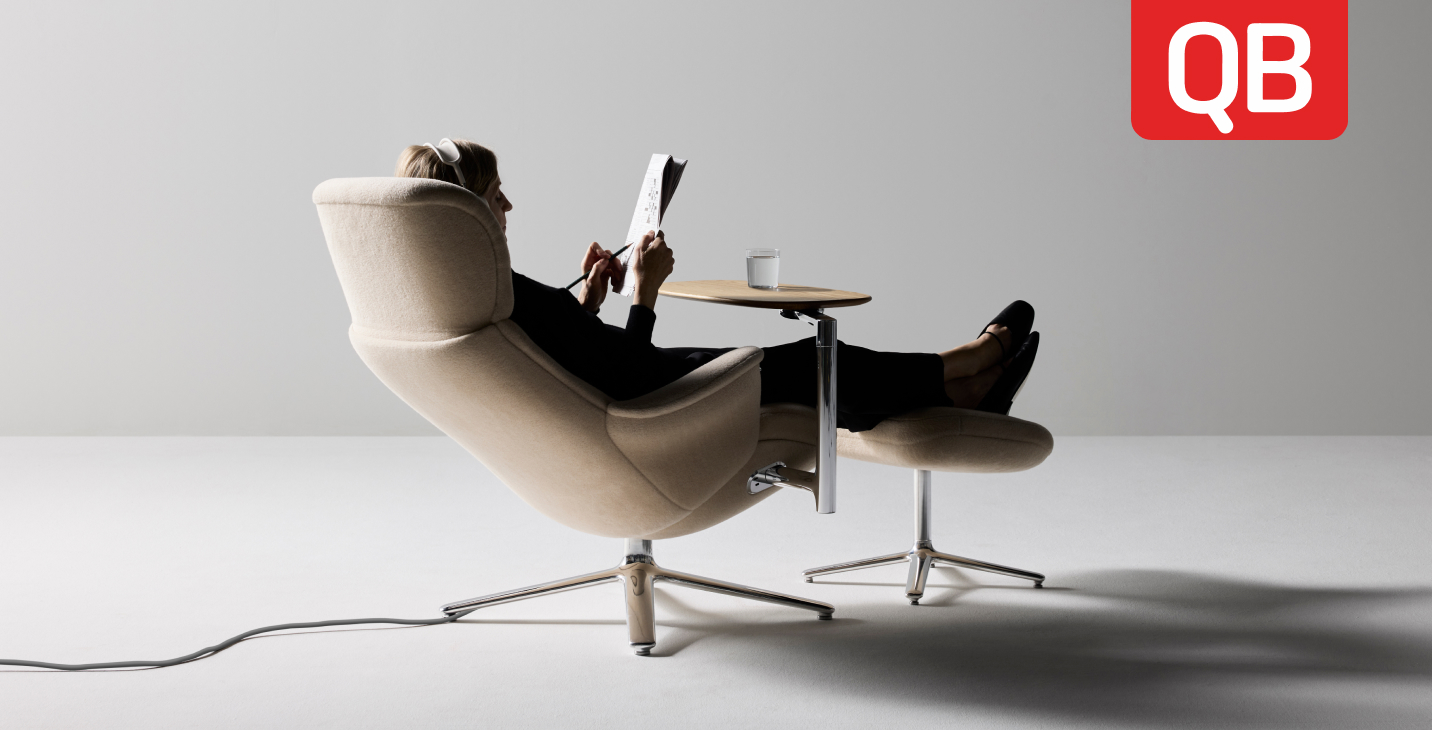
The Diffrient Lounge keeps the intellectual DNA intact: reclined posture, integrated table, the idea that productivity doesn’t happen at 90 degrees. But now it layers in modern realities—USB-C power, motorized adjustments, and a design language that softens the clinical edge into something that actually belongs in a home.
And yes, it costs around $15,000 fully loaded.
Which, in context, might be the most surprising part of the story.
Because if the Jefferson was a $30,000 idea priced at $10,000 too early, the Diffrient Lounge is arguably a $30,000 idea being sold for half that price at exactly the right moment.
That’s not inflation—that’s timing.
Of course, any time a lounge chair enters five-figure territory, there’s an inevitable comparison to the less expensive Eames Lounge Chair, the industry’s gold standard since its introduction in 1956. What’s often forgotten is that Charles and Ray Eames spent years developing that chair—experimenting with molded plywood, refining ergonomics, and obsessing over production techniques before it ever reached Herman Miller’s floor. When it debuted, it retailed for roughly $310, which was astronomical at the time—the equivalent of several thousand dollars today—and firmly positioned it as a luxury object, not a mass-market seat.
Sound familiar?
The difference is that the Eames Lounge was designed for lounging. It became iconic because it was beautiful, (mostly) comfortable, and emotionally resonant. But as Humanscale’s own team—and now WIRED—points out, it was never built for sustained work. The Diffrient Lounge is explicitly designed to close that gap, positioning itself as what you might call “Eames 2.0”—not a replacement, but a reinterpretation for a hybrid world where work, rest, and screen time collapse into a single posture.
And here’s where WIRED got it right in their review: the chair works. Not just as an object, but as an experience. It supports multiple postures without asking the user to think about it, which has always been Diffrient’s core philosophy. No knobs. No instructions. No “ergonomic theater.” Just a chair that adapts.
That simplicity, ironically, is where the complexity lives.
Underneath the clean lines is a deeply engineered system that took more than a decade to refine—mechanical recline, responsive headrest behavior, integrated power that can be upgraded over time. This is Humanscale doing what it has always done best: hiding the hard work so the user never sees it.
But let’s be clear about what this really represents.
This isn’t just Humanscale entering the residential market. It’s Humanscale making a bet—that the future of work is not the desk, not the bench, not the cubicle revival we keep hearing about—but the chair. Specifically, the chair as a complete environment.
Diffrient understood that in 1984. The market didn’t.
In 2026, the market might finally be catching up.
And that’s why this launch feels less like a debut and more like a resolution. A 15-year development cycle. A 40-year-old idea. A 70-year lineage tracing back to the Eameses. All converging into a single object that asks a deceptively simple question: what if the most productive place to work isn’t upright at all?
At $15,000, the Diffrient Lounge won’t be ubiquitous. It’s not supposed to be. Neither was the Eames Lounge. But if history is any guide, the influence of this chair won’t be measured in units sold—it will be measured in how many others try, and fail, to replicate the idea.
We’ve been waiting for this chair since 2011.
Turns out, it was worth the wait.
Meanwhile, Back in the “Office”
If the Diffrient Lounge represents a beautifully resolved vision of how people could work, the rest of the market this week offered a masterclass in how they actually are working—and it’s not nearly as elegant.
Start with the good news: the U.S. office market is “stabilizing.” Which, translated from broker-speak, means vacancy is still sitting at a very healthy 17.6%, rents are quietly sliding, and the only real reason things don’t look worse is because developers have essentially stopped building office buildings. The construction pipeline has collapsed to just 0.4% of total inventory, which is less “confidence returning” and more “everyone put the pencils down.” Manhattan is still trading, the Midwest is still affordable, and the Sun Belt is still pretending it invented office demand—but let’s not confuse a supply freeze with a demand renaissance.
Then there’s the small matter of actually building anything new. Construction input costs decided to remind everyone who’s in charge, jumping at a 12.6% annualized rate to start the year. Energy prices are up, materials are up, labor is up, and if the geopolitical situation in Iran continues to do what geopolitical situations tend to do, expect that trend to continue. The result? Fewer starts, thinner margins, and a growing appreciation for the phrase “value engineering,” which, as always, means “make it cheaper and hope no one notices.”
And yet, in the middle of all this, we’re being told that the office has never been more important.
Thanks to AI, no less.
AI power users, it turns out, are not sitting dutifully at their assigned desks. They’re mobile, nomadic, bouncing between coworking spaces, client sites, and anywhere else that has Wi-Fi and decent coffee. They’re also more engaged, more collaborative, and more focused on learning than their less tech-forward peers. In other words, the most valuable employees in your organization are the least likely to be sitting in the seat you just bought for them.
Which creates a bit of a design problem.
Because the same research breathlessly tells us that the ideal workplace now needs to be beautiful, flexible, quiet and collaborative, tech-enabled, socially dynamic, and somehow capable of supporting both deep focus and spontaneous interaction—often at the same time, in the same footprint, with the same budget that just got cut because construction costs went up 12%.
No pressure.
And just as companies are digesting that, along comes the return-to-office reality check. Firms like Amazon and JPMorgan are bringing people back five days a week, only to discover that their offices—designed for a different era—don’t actually work. Meeting rooms are overbooked, desks are doubling as conference centers, phone calls are happening in hallways, and employees are improvising their way through environments that were supposed to be “best in class” just a few years ago.
It’s almost as if forcing people back into space that wasn’t designed for how they work today creates…friction.
Which brings us, somewhat inevitably, back to the Diffrient Lounge.
Because while the broader market is busy stabilizing, repricing, downsizing, upsizing, and generally contradicting itself, Humanscale quietly spent a decade solving a much simpler problem: how should a human being actually sit, think, and work?
One side of the industry is arguing about vacancy rates and construction pipelines.
The other just built a $15,000 chair that assumes the desk might not matter anymore.
If you’re looking for where this is all heading, that’s probably your tell.
To learn more about Diffrient Lounge and its key features, explore and shop here.